
NGX Rights Issues and Public Offers: Why Your Shares May Show a Different Price
Distinguish subscription cost, broker display values and market prices when newly allotted shares appear in your account.
Introduction
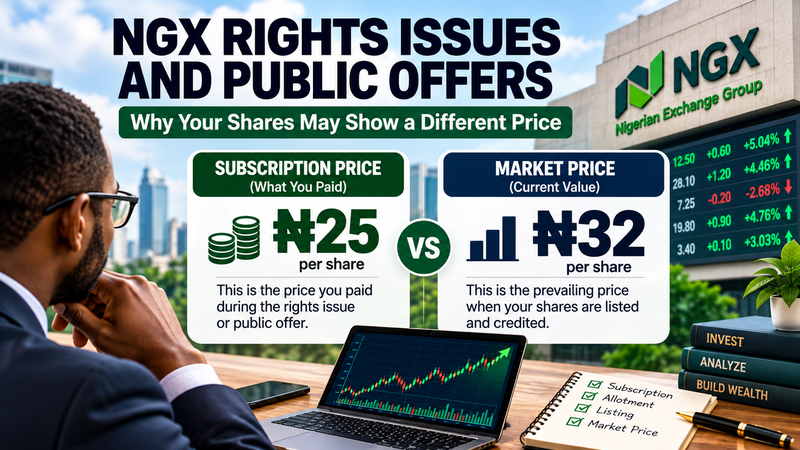
You subscribed for shares in a Nigerian company at ₦25 per share. After waiting several weeks for allotment and processing, the shares finally appear in your brokerage account.
But something looks different.
Instead of ₦25, your portfolio shows ₦32 per share. Alternatively, it may show ₦20.
Has your subscription price changed? Have you made a profit or suffered a loss? Has your stockbroker recorded your investment incorrectly?
These questions are common among investors participating in rights issues, public offers, and initial public offerings (IPOs) on the Nigerian Exchange (NGX).
The confusion arises because the price paid to acquire shares and the price used to value those shares in the market are two different things.
This article explains the difference, what happens between subscription and share crediting, how brokerage platforms value newly allotted shares, how to calculate your actual investment performance, and what to do when your brokerage account displays an incorrect acquisition cost.
1. Understand the Four Prices and Values That Matter
Before examining rights issues and public offers, investors should understand four important concepts.
Subscription Price
The price per share specified in the official offer documents. This is the amount an investor agrees to pay for each share subscribed.
Acquisition Cost
The actual cost of acquiring the shares, including the subscription amount and any applicable acquisition charges.
Market Price
The prevailing price at which shares trade on the exchange, or the latest price used by a broker to value the holding.
Portfolio Market Value
The current estimated value of an investor's shareholding, generally calculated by multiplying the number of shares held by their prevailing market price.
These figures serve different purposes and should not be confused.
Practical Example
Suppose you subscribe for 10,000 shares at ₦25 each.
Your subscription cost is:
10,000 × ₦25 = ₦250,000
Several weeks later, the shares appear in your brokerage account when the market price is ₦32.
Your portfolio market value becomes:
10,000 × ₦32 = ₦320,000
Your original subscription cost remains ₦250,000.
Your unrealized gain is ₦70,000, excluding applicable charges and taxes.
The important distinction is that your shares have increased in market value. The amount you originally paid has not changed.
2. What Happens After You Subscribe for Shares?
When investors subscribe for a rights issue or public offer, the shares do not necessarily appear in their brokerage accounts immediately.
A typical transaction passes through several stages.
Stage 1: Subscription
Investors submit applications and make payments at the price specified in the offer documents.
Stage 2: Offer Closure
The offer closes on the announced date, subject to any officially approved extension.
Stage 3: Application Reconciliation
The issuing house and other transaction participants reconcile applications and payments.
Stage 4: Allotment
The number of shares allocated to each investor is determined through the applicable allotment process.
An investor may receive all the shares requested, a partial allocation, or no shares.
Stage 5: Regulatory Clearance
Required approvals and clearances are completed, including applicable Securities and Exchange Commission (SEC) processes.
Stage 6: Refunds
Where investors receive fewer shares than they paid for, excess subscription funds are refunded according to the offer terms.
Stage 7: CSCS Crediting
Allotted shares are credited through the Central Securities Clearing System (CSCS), using the applicable account and registrar arrangements.
Stage 8: Admission to Trading and Brokerage Updates
Where required, the newly issued shares are admitted to trading on the NGX.
The investor's brokerage platform subsequently reflects the credited shares and associated portfolio information.
These stages explain why investors may wait weeks or months between payment and seeing their shares in their portfolios.
The precise sequence and timing depend on the transaction. Investors should consult the approved prospectus, official allotment announcements, and communications from their stockbrokers.
3. Why Does Your Brokerage Account Show a Different Price?
This is the central issue.
A brokerage account may display several figures relating to the same investment, including:
- Number of shares held
- Subscription price
- Average acquisition cost
- Current market price
- Total acquisition cost
- Current portfolio value
- Unrealized profit or loss
However, different brokerage platforms present these figures differently.
Some platforms automatically value newly credited shares using the prevailing market price.
Others separately maintain the original acquisition cost and calculate investment returns from that figure.
In some cases, newly allotted shares may initially appear without the correct historical acquisition cost because the portfolio system has not fully reconciled the transaction.
Practical Example: Understanding Your Portfolio
Suppose you subscribed for 10,000 shares at ₦25 each.
When the shares appear in your brokerage account, the prevailing market price is ₦32.
Your portfolio should be interpreted as follows:
- Shares held: 10,000
- Original subscription price: ₦25 per share
- Original subscription cost: ₦250,000
- Current market price: ₦32 per share
- Current portfolio market value: ₦320,000
- Unrealized gain: ₦70,000
This presentation correctly distinguishes the original investment from its current market valuation.
However, if your platform displays ₦32 as your average acquisition price, even though you paid ₦25, the historical cost information may be incorrect or incomplete.
Investor takeaway: A market price displayed in your portfolio does not necessarily represent your original purchase price.
4. Example One: The Market Price Rises Before Your Shares Appear
Consider an investor who subscribes for 10,000 shares at ₦25 each.
The shares are subsequently credited when the market price is ₦32.
Original Investment
10,000 shares × ₦25 = ₦250,000
Current Market Value
10,000 shares × ₦32 = ₦320,000
Unrealized Profit
₦320,000 − ₦250,000 = ₦70,000
Percentage Return
(₦70,000 ÷ ₦250,000) × 100 = 28%
Investment Summary
- Shares allotted: 10,000
- Subscription price: ₦25 per share
- Total subscription cost: ₦250,000
- Current market price: ₦32 per share
- Current market value: ₦320,000
- Unrealized profit: ₦70,000
- Unrealized return: 28%
The investor has an unrealized gain of ₦70,000 before applicable transaction charges and taxes.
This gain does not become cash simply because the portfolio displays a higher valuation.
It is realized through a sale, subject to the actual execution price and transaction costs.
5. Example Two: The Market Price Falls Before Your Shares Appear
Now consider the opposite situation.
An investor subscribes for 10,000 shares at ₦25 each, but the prevailing market price is ₦20 when the shares are credited.
Original Investment
10,000 shares × ₦25 = ₦250,000
Current Market Value
10,000 shares × ₦20 = ₦200,000
Unrealized Loss
₦200,000 − ₦250,000 = −₦50,000
Percentage Return
(−₦50,000 ÷ ₦250,000) × 100 = −20%
Investment Summary
- Shares allotted: 10,000
- Subscription price: ₦25 per share
- Total subscription cost: ₦250,000
- Current market price: ₦20 per share
- Current market value: ₦200,000
- Unrealized loss: ₦50,000
- Unrealized return: −20%
The investor has an unrealized loss of ₦50,000.
This does not mean the stockbroker changed the subscription price to ₦20.
It means the market currently values the shares below their original subscription price.
The loss remains unrealized while the investor continues to hold the shares. If the investor sells at ₦20, the loss becomes realized, subject to applicable transaction costs.
6. Comparing the Two Outcomes
Consider two investors who each subscribed for 10,000 shares at ₦25 per share, representing an original investment of ₦250,000.
Scenario A: Market Price Rises to ₦32
- Original investment: ₦250,000
- Current market value: ₦320,000
- Unrealized gain: ₦70,000
- Percentage return: +28%
Scenario B: Market Price Falls to ₦20
- Original investment: ₦250,000
- Current market value: ₦200,000
- Unrealized loss: ₦50,000
- Percentage return: −20%
What Do These Examples Demonstrate?
Both investors originally paid ₦25 per share.
Their investment costs remain the same, but their current market valuations differ.
The subscription price determines the original purchase amount. The prevailing market price determines the current market valuation.
These calculations exclude transaction charges, taxes, dividends, and other corporate actions.
7. Rights Issues and Public Offers: What Is the Difference?
Both methods can be used to raise capital, but their structures differ.
Rights Issue
A rights issue generally allows existing shareholders to subscribe for additional shares based on their holdings on a specified qualification date.
For example, a company may offer one new share for every five shares already held.
Key characteristics:
- Eligibility: Existing shareholders who qualify under the offer terms.
- Pricing: The subscription price is specified in the offer documents and may be discounted relative to the prevailing market price.
- Allocation: Based on shareholder entitlements and applicable rules for additional applications.
- Listing status: Usually involves a company already listed on the NGX.
- Market risk: Share prices may rise or fall before or after allotment.
- Refunds: May apply to unsuccessful or excess applications.
A rights issue discount does not guarantee an investment profit.
Public Offer
A public offer makes shares available to eligible investors under the terms of the offering.
It may involve a company issuing new shares or existing shareholders selling shares.
A public offer may also form part of an IPO, where a company seeks admission to the NGX for the first time.
Key characteristics:
- Eligibility: Members of the public or specified investor categories.
- Pricing: The offer price is established under the transaction terms.
- Allocation: Based on the approved allotment process.
- Listing status: May involve a newly listed company or additional shares issued by an existing listed company.
- Market risk: Share prices may rise or fall after admission to trading.
- Refunds: May apply where applications are unsuccessful or partially allotted.
The Important Distinction
A rights issue by an existing NGX company does not necessarily involve listing the company again.
Instead, the additional shares may be admitted to trading alongside its existing shares.
A public offer may involve an initial public offering or an additional issuance by an already listed company.
Investors should consult the official offer documents to understand the applicable terms.
8. Why the Market Price Can Change During the Waiting Period
The share price of an already listed company may continue to fluctuate while investors wait for rights issue or public offer shares to be allotted and credited.
Several factors can influence the price.
Company Performance
Changes in earnings, profitability, debt, or future growth expectations can influence investor demand.
Market Sentiment
Positive or negative developments affecting the Nigerian stock market can influence prices.
Interest Rates and Economic Conditions
Inflation, exchange rates, monetary policy, and economic uncertainty may affect equity valuations.
Increased Share Supply
Issuing additional shares increases the company's shares outstanding. The effect on price depends on the issue terms, proceeds, market expectations, and other factors.
Rights-Related Price Adjustments
In a rights issue, the share price may adjust when the shares begin trading without the entitlement to the rights.
Investors should therefore be careful when comparing the subscription price with an earlier market price.
A price adjustment associated with the rights entitlement is not necessarily a sudden destruction of shareholder value.
Investor Expectations
Market participants may revise their assessment of a company's future prospects before the new shares are credited.
For a new IPO, the situation is different because there may be no established NGX trading price before the company's first trading session.
In that case, the initial post-listing market price emerges through the exchange's trading process.
9. What Happens When You Receive Fewer Shares Than You Requested?
Suppose an investor subscribes for 10,000 shares at ₦25 each.
The investor pays ₦250,000 but receives only 7,500 shares.
Subscription and Allotment Details
- Shares requested: 10,000
- Subscription price: ₦25 per share
- Total amount paid: ₦250,000
- Shares actually allotted: 7,500
- Cost of allotted shares: ₦187,500
- Refund due: ₦62,500
Calculating the Actual Investment
7,500 shares × ₦25 = ₦187,500
Calculating the Refund
₦250,000 − ₦187,500 = ₦62,500
Assuming no additional charges, the investor's actual subscription cost is ₦187,500, not ₦250,000.
If the allotted shares subsequently trade at ₦32:
Current market value:
7,500 × ₦32 = ₦240,000
Unrealized gain:
₦240,000 − ₦187,500 = ₦52,500
This example demonstrates why investors must reconcile their original payments, final allotments, and refunds before calculating investment performance.
10. How to Verify Your Actual Acquisition Cost
If the price displayed in your portfolio differs from what you paid, follow these steps.
Step 1: Check Your Subscription Confirmation
Review your payment receipt or application confirmation.
Identify the subscription price, number of shares requested, and total amount paid.
Step 2: Confirm Your Final Allotment
Check the official allotment confirmation.
The number of shares applied for may differ from the number actually allotted.
Step 3: Verify Your CSCS Credit
Confirm that the allotted shares have been credited to the correct securities account.
Your CSCS record can help establish the quantity and ownership of the shares, although it may not provide all the acquisition-cost details maintained by your broker.
Step 4: Review Your Brokerage Transaction History
Look for the allotment or corporate-action entry.
Compare the quantity, recorded cost, and any adjustments.
Step 5: Examine the Portfolio Column Headings
Determine whether the displayed price refers to the current market price or the historical average acquisition cost.
Step 6: Contact Your Stockbroker
If the acquisition cost is incorrect, request clarification or correction.
You may use the following message:
Subject: Request for Verification of Share Acquisition Cost
Dear Support Team,
I subscribed for shares in [Company Name] at ₦[Subscription Price] per share.
The allotted shares have been credited to my brokerage account, but the displayed acquisition price differs from my subscription price.
Kindly verify the recorded cost basis, share quantity, and current market valuation, and correct any discrepancy.
My subscription confirmation and allotment details are available for verification.
Thank you.
11. Why an Incorrect Cost Basis Matters
An inaccurate acquisition cost can mislead investors about their actual investment performance.
For example, suppose you subscribed for 10,000 shares at ₦25.
The market price is now ₦32.
If your broker incorrectly records ₦32 as the purchase price, the platform may calculate your unrealized gain as zero.
However, your actual gain before charges is ₦70,000.
This discrepancy can affect:
- Portfolio performance reports
- Average purchase price calculations
- Unrealized profit and loss figures
- Investment decision-making
- Personal recordkeeping
- Tax-related calculations where applicable
It becomes even more important when an investor already owns shares in the same company.
Existing Shareholding Example
Suppose you previously owned 5,000 shares purchased at ₦40 each.
You subsequently receive 5,000 additional shares through a rights issue at ₦25 each.
Your total investment cost becomes:
Existing shares:
5,000 × ₦40 = ₦200,000
Rights issue shares:
5,000 × ₦25 = ₦125,000
Combined acquisition cost:
₦200,000 + ₦125,000 = ₦325,000
Total shares held:
5,000 + 5,000 = 10,000 shares
Calculating the New Average Acquisition Price
₦325,000 ÷ 10,000 = ₦32.50 per share
This calculation excludes charges and assumes no other cost-basis adjustments.
If the market price is ₦35, the total market value is ₦350,000.
Your unrealized gain is:
₦350,000 − ₦325,000 = ₦25,000
Investors should distinguish the price paid for a particular rights issue from the weighted average cost of their entire holding.
12. Should You Sell Immediately When Your Shares Are Credited?
Not necessarily.
The appearance of newly allotted shares in your brokerage account should not automatically trigger a sale.
Your decision should depend on your investment objectives, the company's fundamentals, valuation, market conditions, and investment horizon.
Ask yourself:
- Why did I originally subscribe?
- Has the company's investment outlook changed?
- Is the current market price attractive relative to its fundamentals?
- Do I need the money immediately?
- Is the stock sufficiently liquid?
- Would selling improve my overall portfolio?
- What are the transaction costs and potential tax implications?
A short-term investor and a long-term shareholder may respond differently to the same market price.
A gain on the portfolio screen is not a reason to abandon a sound investment strategy without analysis.
Likewise, a temporary market loss does not automatically justify holding indefinitely if the company's fundamentals have deteriorated.
13. Use Stock Analysis Before Making Your Next Decision
Once your shares are credited and trading, the next question is whether to hold, sell, or increase your investment.
That decision requires more than comparing the subscription price with the current market price.
Investors should examine:
- Revenue and earnings growth
- Profit margins
- Debt and financial stability
- Dividend history
- Price-to-earnings valuation
- Trading volume and liquidity
- Historical price performance
- Industry prospects
- Corporate governance
The TopChor Nigeria Stocks Screener helps investors screen NGX-listed companies, compare available financial and market indicators, and identify stocks for further research.
A stock screener does not replace careful analysis, but it helps investors make more structured, evidence-based decisions.
14. Frequently Asked Questions
Has my subscription price changed because my portfolio shows a higher price?
No. The original subscription price remains the price agreed under the offer. The higher figure may represent the prevailing market price or a portfolio-recording issue.
Does a higher portfolio value mean I have already received a profit?
No. An increase in market value generally represents an unrealized gain until the shares are sold.
What if my shares appear at a lower price than I paid?
Your investment has an unrealized loss based on the prevailing market valuation. The original acquisition price does not change merely because the market price has fallen.
Does the stockbroker automatically change the acquisition cost to the listing-day price?
Not necessarily. Brokers should distinguish historical cost information from market valuation, but the way they maintain and display records varies. An incorrect cost basis should be investigated.
Can the shares appear in CSCS before they appear in my brokerage app?
Yes. CSCS crediting and brokerage portfolio updates are separate operational processes, so their visibility may not be simultaneous.
Is a rights issue subscription price always lower than the market price?
No. Although rights issues are often priced at a discount, the offer terms and prevailing market conditions determine the comparison.
Can I sell my shares immediately after allotment?
Not necessarily. The shares must be eligible and available for trading, and any applicable listing, crediting, or trading restrictions must be satisfied.
How do I know whether my shares were fully allotted?
Check the official allotment confirmation, your securities account, and any applicable refund records.
What if my broker records the wrong average purchase price?
Provide your subscription receipt, allotment statement, and relevant transaction records. Request verification and correction.
Does the current market price guarantee what I will receive when I sell?
No. Actual execution depends on available buyers, trading volume, bid and ask prices, and market conditions.
15. Practical Checklist for NGX Investors
Before concluding that your portfolio is showing the wrong price, confirm the following:
- Your original subscription price.
- The number of shares applied for.
- The number of shares actually allotted.
- Any refunds received or outstanding.
- The quantity credited to CSCS.
- The current market price.
- The acquisition cost recorded by your broker.
- The average acquisition cost of your entire holding.
- The accuracy of your unrealized gain or loss.
- Whether any discrepancy requires correction.
Retain your supporting documents, especially if you invest in multiple rights issues or public offers over time.
Conclusion
When shares acquired through a rights issue or public offer appear in your NGX brokerage account at a price different from the subscription price, it does not necessarily mean your original investment cost has changed.
The subscription price represents what you paid for the allotted shares.
The market price represents what those shares are currently worth.
The portfolio market value reflects the current valuation of your holding.
The acquisition cost should reflect the amount attributable to the shares acquired, including applicable charges and relevant adjustments.
Because market prices can change between subscription, allotment, CSCS crediting, and admission to trading, investors may see substantial differences between what they originally paid and what their portfolios subsequently display.
The most important lesson is to maintain accurate records, understand your broker's reporting system, and calculate investment performance using the correct acquisition cost.
In the Nigerian stock market, knowing what you paid is just as important as knowing what your shares are worth today.
Investor Insight
Your subscription price tells you what you paid. Your market price tells you what your shares are worth today. Your true return depends on understanding both.
Dr. Babs Odunsi
Dr. Babs Odunsi is a financial expert focused on explaining stock market fundamentals and investment concepts in simple, practical terms.
More articles by Dr. Babs Odunsi →